



By Laura Legere
Pittsburgh Post-Gazette
(TNS)
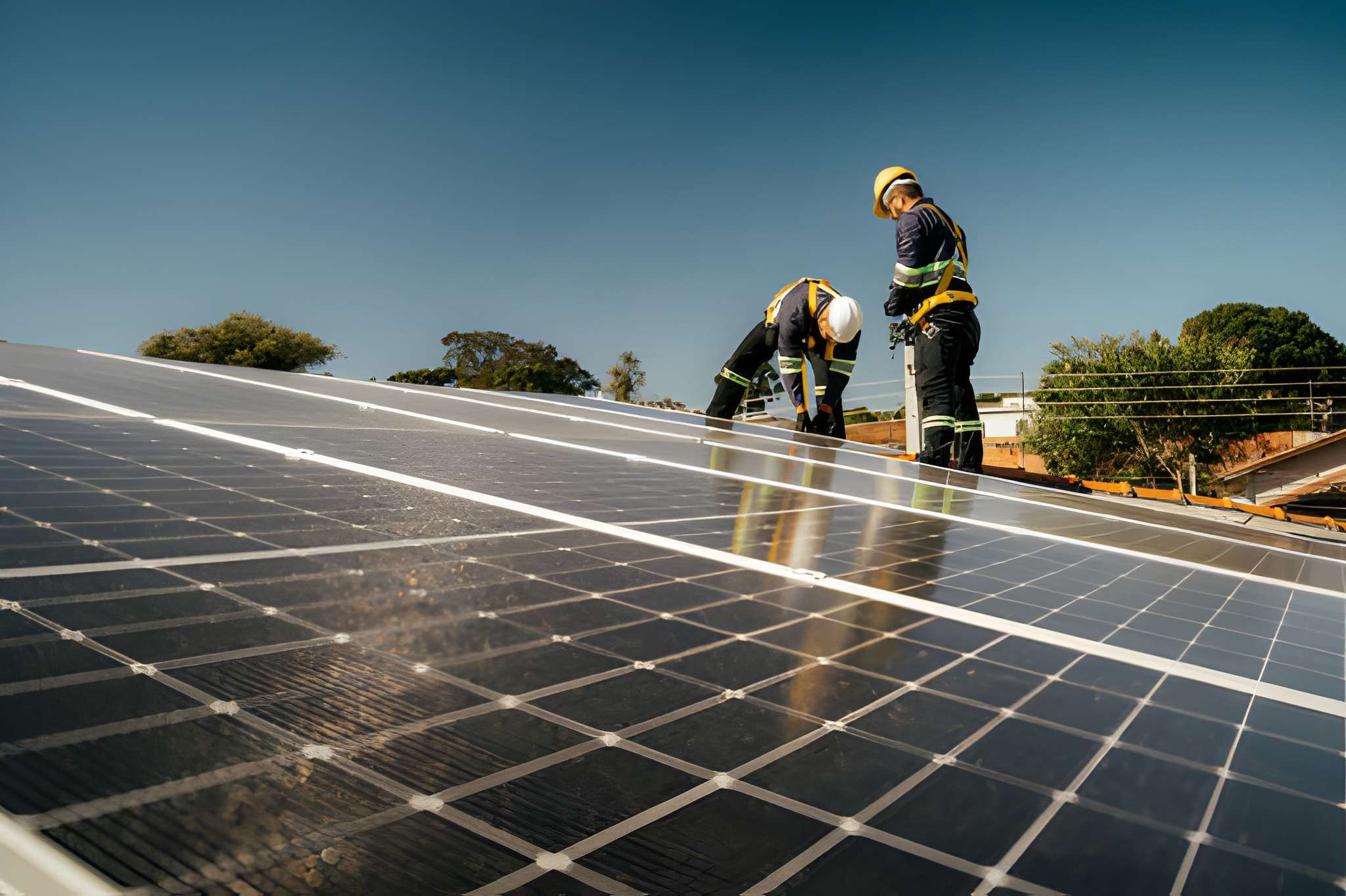
Jan. 4 — In the waning days of December, a clatter on the rooftop might not have been the sound of nine magic reindeer. It was probably the noise of a team of solar installers facing their own daunting deadline.
With a Dec. 31 deadline to connect solar panels before a significant federal tax credit for homeowners expired, installers were racing to mount panels before the incentive evaporated.
For a mid-December installation on Brighton Road, “they were scraping off several inches of ice from the roof before they could put the racking down to mount the panels,” said Rachel Pecharka, a Pennsylvania program associate for the nonprofit Solar United Neighbors.
The words she and others used to describe the past few months were “mad rush.”
The federal spending and policy law President Donald Trump signed in July put an end to a tax credit for homeowners worth 30% of the cost of a solar installation for their residence. For the average residential solar project in Pennsylvania, the value of the credit was $4,000, according to the clean energy marketplace EnergySage, but it could easily be double that amount.
Recommended Articles

Suddenly, homeowners had less than six months to get solar panels on their roofs to meet the deadline.
“When it was announced, there was a massive influx of demand,” said Will Brown, sales director at Green Rack, a solar installation company based in Robinson and Columbus, Ohio. “We saw in July and August about a four-times increase in sales, which may have been more like a five- to 10-times increase in inquiries.”
Renewables watchers call it the “solarcoaster:” the cycles of surging demand followed by steep drops tied to cutoffs or extensions of tax credits and other incentives.
The Inflation Reduction Act, signed by President Joe Biden in August 2022, had promised to turn that bumpy ride into a straightaway: the law extended the 30% tax credit for residential installations through 2032, with lower tax credits for the following two years, giving the industry a predictable policy for a full decade.
That emboldened companies to grow their businesses, hire more workers and invest in manufacturing in the United States.
In Pennsylvania, the annual amount of installed solar generating capacity more than doubled between 2022 and 2023, then doubled again between 2023 and 2024, according to records from the state Public Utility Commission.
When the Inflation Reduction Act was signed, there had been about 36,000 total registered solar projects built on the state’s roofs and fields over the previous two decades. By the end of 2025, there were over 80,000.
That growth made the abrupt end of the residential solar tax credit on Dec. 31 a particularly stomach-dropping shift.
“We’re seeing a loss of jobs. We’ve seen companies already filing for bankruptcy, and we’re going to see more of it next year, unfortunately,” said Sharon Pillar, executive director of the nonprofit Pennsylvania Solar Center, based in the Hill District.
Allegheny County leads the state in the number of solar installations, with more than 8,100 through the end of 2025. (Philadelphia County is second, with about 6,400.)
But Allegheny ranks 10th in terms of the capacity of solar installed, with its systems capable of producing 72 megawatts of AC power. Rural Franklin County leads the state with about 400 megawatts of AC capacity, mainly from a few large, utility-scale solar farms.
That indicates that in the Pittsburgh region, residential solar has been a primary driver of growth—with each rooftop array adding up to local jobs—and its decline could have an outsized impact.
‘They’re thinking it’s a bait and switch’
In the run-up to the deadline, things got “absolutely chaotic,” Mr. Brown said.
In August, he said, large companies that had the financial means began hoarding the available premium panels in warehouses across the country.
Solar panel distributors began notifying smaller companies, like Green Rack with its roughly 50 employees, that they would not be able to fulfill many of their outstanding orders by the end of the year.
Between Green Rack and its two sister companies in the Washington-area and Florida, “we had purchase orders to the tune of roughly 7,000 panels that got pulled out from under us,” he said. They were no longer able to get the panels they were promised for jobs that had “already been sold, designed, engineered, permitted and submitted for interconnection with the utility.”
That meant, essentially, starting over—re-selling and re-engineering the projects with replacement panels with different wattage and dimensions, and without the brand names that homeowners had been sold on.
Customers were, understandably, “a little bit wary,” he said, even though the company passed along the price savings. “They’re thinking it’s a bait and switch.”
At the same time, new customers were rushing to get into the queue on top of the pileup of projects that had to be re-designed. Everything was taking longer than expected.
Anxious customers began calling for updates “daily, sometimes multiple times a day.”
By October, the company was telling inquiring homeowners that new signups would not make the tax-credit deadline, so sales hit a trough even as call volumes remained sky high.
For the handful of existing contracts that Green Rack realized wouldn’t get installed before the end of the year, the company made a decision: it would give those customers the full value of the tax credit in the form of a direct discount, and Green Rack would absorb the cost.
He hoped the move would send a message: “This is what we do because this is what we care about,” Mr. Brown said. “We’re not in this for the short term.”
‘The rest of the entire world is moving in this direction’
Now that the rush is over, solar companies that serve residential customers are preparing to pivot to stay viable in 2026 and beyond.
One pathway is to pitch rooftop solar as a way to lock in low energy costs for decades at a time when utility bills are rapidly rising.
“Based on our current pricing, we are—without the tax credit, without any federal subsidies—offering the same payback periods that customers were getting in 2019 with the tax credit,” Mr. Brown said, because of how much equipment prices have gone down and utility rates are going up.
Residential-focused solar installers like Green Rack, with a stable of skilled electricians, might diversify into heat pump installations, home energy efficiency upgrades or general commercial electric work.
Developers are also likely to increasingly promote solar leases or power purchase agreements, where a third-party company owns the solar panels on a home’s roof, but the homeowner gets to buy the electrical output at a discounted monthly rate.
Companies that own leased solar panels still qualify for a commercial tax credit through 2027, depending on some still incompletely defined rules restricting the use of equipment from China and other countries “of concern.”
“I anticipate, once those leasing programs are out there, that people will gain interest again,” Ms. Pillar said. “Because it’s just a way to go solar with no money down, no money required, and if they can show that you’re going to have a reduction in your electricity price, it’s kind of a no-brainer to do that.”
Another pathway is the expansion of solar cooperative or “group buy” programs, like those organized by Solar United Neighbors, where homeowners in an area sign up to work with one vetted installer, which lowers the price for everyone.
Ms. Pecharka said the recent Switch Together program, which ran in the greater Pittsburgh area, cut installation costs by an average of $4,000 per home—or around 18% off the market rate.
About 40 homeowners in the city signed contracts and roughly another 100 have proposals and could choose to sign a contract, she said, although those would not qualify for the tax credit. Green Rack was the winning installer for this round.
There will be a new enrollment round in April.
“Group buy programs are able to help provide some steady assurance for installers that they will still be having business come in” now that the tax credit has expired, she said. “It helps homeowners; it helps the installers.”
And as regional electric grids face unprecedented demand for more power from data centers coming online, political sentiment might change.
“There are a lot of legislators on both sides of the aisle that understand that we need more electricity on the grid, that prices are rising, that solar is the fastest deployable resource,” Ms. Pillar said.
“I think this is a temporary—unfortunate, but temporary—slowdown in the market, because the rest of the entire world is moving in this direction.”
Photo credit: Drs Producoes/iStock
______
© 2026 the Pittsburgh Post-Gazette. Visit www.post-gazette.com. Distributed by Tribune Content Agency LLC.

Thanks for reading CPA Practice Advisor!
Subscribe Already registered? Log In
Need more information? Read the FAQs