


The IRS is shutting down its self-service kiosk program at Taxpayer Assistance Centers after the Treasury Inspector General for Tax Administration (TIGTA) expressed concerns to the agency that several of the computer terminals were unusable.
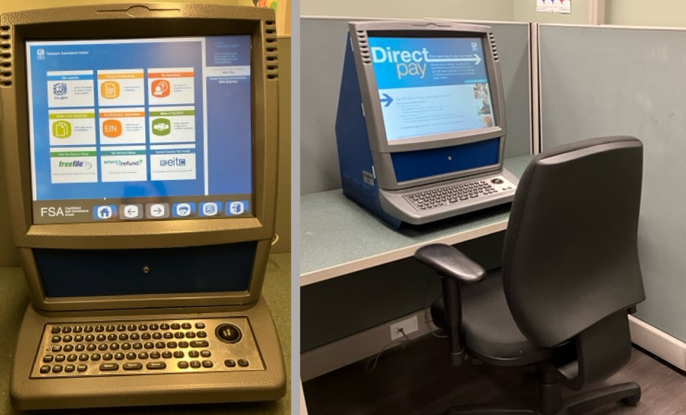
As of April 2024, the IRS had 100 facilitated self-assistance kiosks located at 37 of its 363 TACs. According to TIGTA, the kiosks are stand-alone booth structures installed in 2011. The kiosks open in the front and are hooked up to a laptop computer. They connect to the IRS’s website and are designed to give taxpayers the tools and support to help themselves to IRS services. For example, a taxpayer can use a kiosk to get tax transcripts from prior years or apply for an employer identification number.
However, a review by TIGTA found that 55 of the 100 kiosks worked well, but 40 were inoperable and the status of five were unknown.
“The machines appear dated and do not use modern technology,” TIGTA said in a report issued earlier this week. “For instance, instead of using a computer mouse, which most individuals would be familiar with using, the kiosks use a trackball to navigate through screens.”
The IRS awarded a $500,000 annual contract to a vendor in June 2021 for the monitoring and maintenance of the kiosks. The report says the vendor was responsible for providing fully managed services to supply and maintain the kiosks, including:
- All necessary hardware, software content, printer toner cartridges, network gear, cabling, wiring, live helpdesk, on-site support services, content management, and online reports.
- The setup, management, and support of high-speed internet service, as well as program management oversight.
- Printer support, on-site services, component repair or replacement parts, and printer toner replacement.
- Weekly reporting to the IRS program manager to ensure timely, fully managed services for supply and maintenance of the kiosks.
However, TIGTA evaluators identified certain items that weren’t a part of the contract, including:
- Concessions (i.e., reduced payment amounts) for delays in repairing kiosks.
- Criteria for repair time frames.
“IRS management stated that the contractor’s service-level agreement outlines the contractor’s commitment to customer support,” TIGTA said in the report. “We found that the contractor’s customer support agreement outlines a 24-hour response time for repairs, on-site support within 48 hours, available hardware shipped within 48 hours, and expedient resolutions. However, this agreement was not included in the IRS’s contract. Therefore, the contractor could not be held accountable for repair time frames.”
During TIGTA’s review, the IRS was in option year three of the contract. When a kiosk wasn’t working, the TAC manager submitted a service ticket to the contractor. According to IRS management, 137 service tickets were outstanding from February 2023 through August 2024, according to TIGTA. The IRS watchdog also found 24 tickets were open (i.e., the contractor hadn’t performed work on these tickets). The time needed to close the remaining 113 tickets ranged from 30 days or less to 463 days, TIGTA said.
“For Option Year 3, the lack of contract oversight resulted in the IRS paying approximately $500,000 to a contractor that was not performing the necessary services to get the kiosks working in a timely manner. In October 2024, IRS management informed us that the contractor was taking longer to repair the kiosks because parts were no longer being manufactured. However, the goal was to get all the kiosks working by December 31, 2024,” the TIGTA report says. “In January 2025, we visited eight TACs with inoperable kiosks and found the machines were still not working.”
TIGTA also found that the number of taxpayers using kiosks has drastically decreased in recent years. In 2017, more than 80,000 taxpayers used the kiosks, but from January through July 2024, only 4,600 taxpayers used kiosks. The kiosks being outdated and inoperable may explain the decline in usage, the watchdog said.
Some time after its January review that found the eight inoperable kiosks, TIGTA said it learned the IRS didn’t exercise the contract’s option year for 2025, saving $500,000, and was discontinuing the kiosk program, “something IRS management didn’t state plans to do until after we expressed concerns about inoperable kiosks.”
“While we support the IRS’s decision to discontinue the current kiosk program, we believe that offering taxpayers a self-service option could be beneficial as the IRS reduces and restructures its workforce,” TIGTA said.
TIGTA recommended that the IRS perform a study to determine whether a new kiosk program that uses updated technology, or deploys laptops to TACs, would provide effective and efficient self-service options to taxpayers. TIGTA said the IRS agreed with the recommendation and plans to implement the appropriate corrective action.
“Since the installation of the FSA kiosks in 2011, the technology gradually became outdated,” Kenneth Corbin, chief of the IRS’s Taxpayer Services Division, wrote in response to the report. “To address the challenge of aged and failing equipment, we worked with external stakeholders to improve how we tracked and prioritized maintenance. This strengthened our ability to manage repairs and monitor availability across locations. However, based on performance data and user feedback, we determined that the aging equipment no longer met service expectations or supported the needs of taxpayers. For that reason, we decided not to exercise an additional option year of the contract. We will focus on improving digital access to taxpayer services and delivering efficient, dependable support for all taxpayers. We are exploring modern, cost-effective alternatives that ensure continued access to reliable self-service tools.”
Photo caption: Image of a kiosk main screen, left. A kiosk at the TAC in Fort Worth, TX, right. (Treasury Inspector General for Tax Administration)

Thanks for reading CPA Practice Advisor!
Subscribe Already registered? Log In
Need more information? Read the FAQs
Tags: Income Taxes, IRS, kiosks, Taxes, taxpayer assistance centers, TIGTA