
Technology
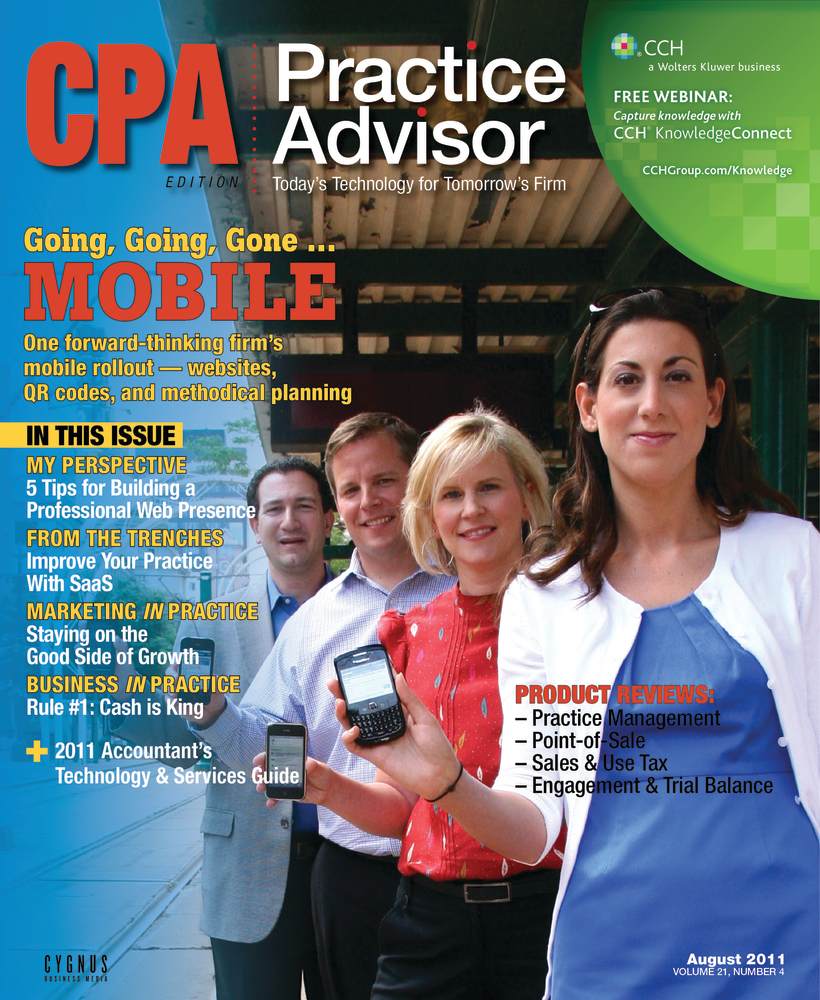
Going, Going, Gone … Mobile
Freed Maxick & Battaglia (FMB) didn’t become a Top 100 firm by avoiding change. In fact, the firm can best be described as the most rapid of rapid adopters — just all in good time. This is not meant to confuse anyone, but is testament to FMB’s stance on staying ahead of change by first thoroughly researching and testing new innovations.
Sep. 05, 2014
Freed Maxick & Battaglia
Eric Majchrzak, Director of Marketing, Freed Maxick & Battaglia, PC
Staying Cautiously Ahead of Change
Freed Maxick & Battaglia (FMB) didn’t become a Top 100 firm by avoiding change. In fact, the firm can best be described as the most rapid of rapid adopters — just all in good time. This is not meant to confuse anyone, but is testament to FMB’s stance on staying ahead of change by first thoroughly researching and testing new innovations.
“We never jump right in,” explained Eric Majchrzak, director of marketing at Freed Maxick & Battaglia. “When a new technology emerges, we participate first, educate ourselves and get comfortable with the platform before launching in the firm. There is certainly an element of risk being an early adopter. With proper planning, we are willing to take risks.”
Over the past few years, there has been a notable trend in the profession. Too often, firms adopt a new technology or platform, like Twitter or Facebook, simply because everyone else is doing it.
“We don’t operate that way,” Majchrzak stated. “We have to get a feel for it first and know that it will provide value. Otherwise, it’s just adoption for the sake of adoption.”
True to form, FMB invested significant time researching the latest phase of their advanced marketing program — QR codes and mobile websites. Majchrzak and his team studied the new technology in order to determine how it fit into their current marketing plan.
Majchrzak explained, “There are many pieces of the puzzle when it comes to a successful marketing program. You can’t just force fit in a new piece. You have to first understand where it fits in and how it will enhance what you are currently doing.”
QR Codes & Mobile Websites 101
QR codes and mobile websites are a new concept in the profession, and not yet fully understood. There is no doubt that these exceptionally cool initiatives will prove to be valuable to firms, but that can’t happen until firms really “get it.” To help, here are few fast definitions:
QR Codes — In simplest terms, QR (Quick Response) codes are barcodes that are readable using a smartphone barcode reader app. QR codes aren’t a new technology. In fact, UPS (United Parcel Service) has used the technology for years. Codes are found on package labels and allow data to be decoded at high speed. In relation to mobile websites, users can scan QR codes and immediately access the site without having to launch a browser or type a long URL.
Mobile Websites — Mobile sites are exactly what they sound like. They are websites that are built to be viewed on mobile devices like a smartphone or iPad. Sites are formatted to display on a smaller screen, which mitigates scrolling to view contents.
Getting into the Mobile Space
Entering the mobile space was a necessity for FMB. With the proliferation of mobile devices, the firm focused on deepening its presence by delivering relevant, current content to financial and business clients that are typically on the go.
The firm’s first QR code-enabled website was launched within the last few months. The mobile site is dedicated to the New York State Excelsior Jobs Program and offers up-to-date information on program criteria and available tax credits. It’s meaningful, timely information that’s easily accessible. And how it works is easy. Users scan the QR code and are immediately directed to the mobile-friendly site.
“The Excelsior site was our first QR code and mobile website initiative,” stated Majchrzak. “Our goal was to put useful information in the hands of our clients through the mobile channel. It’s another powerful touch point.”
The firm also recently sponsored an iPhone application. Partnering with local print and radio media, FMB was able to align its name with the mobile app without having to actually develop it.
“This is another example of how we first educate ourselves on the technology,” said Majchrzak. “We have no experience developing an application, so we left that to the experts. Through a sponsorship, our name is tied to the technology while the onus of development and maintenance is with our partner. This allows us time to get comfortable with the platform until we are ready to develop our own.”
Without Proper Planning, You are Sure to Get Lost
There’s a lot to know about building a successful marketing program. And every day it seems like a new technology trend emerges. It can be overwhelming if you don’t have a structured plan in place. Consider just a few pieces of the puzzle: social media platforms, blogs, email campaigns, direct mail, website, radio and print media … and now QR codes and mobile sites.
“We are always evaluating how we can integrate multiple marketing efforts to maximize investment,” explained Majchrzak. “When we plan a campaign, like the Excelsior mobile site, our goal is to engage the community where we know they reside. So depending on the community that we are trying to reach, the platforms used may vary from campaign to campaign. For example, when the mobile Exclesior site launched, we knew that our financial and business audience could also be reached via radio spots, trade events, targeted print pubs, email blasts and inbound marketing, and select social media platforms.”
Planning is a big part of FMB’s marketing success. In fact, Majchrzak explained the firm’s multi-year rollout for social media. In early 2008, the firm launched its LinkedIn profile, in the fall of 2008 a Facebook page, in 2009 Twitter, and in 2010 YouTube.
“Again, it’s about getting comfortable with the platform first and understanding the value. Once that happens, implementation is far more likely to be successful,” Majchrzak reiterated.
FMB applied the same phased approach to rolling out its mobile program. Majchrzak explained the five-step plan:
- Research and Intelligence — Identify where the audience is in the mobile space, and explore the right technologies to reach that audience.
- Set Goals and Objectives — Pinpoint expected outcomes and specific calls-to-action. Goals provide benchmarks by which the success of the campaign can be measured.
- Develop the Written Plan — Record all action items and tactics required to launch the program. This provides a clear roadmap and keeps the campaign on course.
- Platform and Architecture — Research what other platforms are needed to launch the campaign successfully (e.g., Twitter, billboards, etc.) and develop a flow (or path) of information that ensures that viewers are always directed back to the firm’s website or blog.
- Engagement and Measurement — Measure results to keep up with participation in the program. Review response rates, click-thrus, and other response mechanisms to identify areas in need of improvement.
A Final Word
It’s an exciting time in the profession. There are so many channels available to reach prospects and clients and provide them with meaningful information. The firm of Freed Maxick & Battaglia understands this and has steadily progressed into social media, blogging, smartphone apps, mobile sites, and QR codes to effectively reach defined audiences.
The firm’s core philosophy of “plan first, launch later” has proven effective. Through education and testing, firm leaders have been able to leverage new technology to significantly expand presence. Roll out of social media and the firm’s current venture into mobile apps and QR codes have conformed to a phased approached, proving it’s well worth the time and effort up front to ensure a successful launch.
What’s next for FMB is anybody’s guess. But rest assured that whatever the new initiative, it won’t be launched without proper planning.
[CALL OUT BOX]
Stats at a Glance
- Year founded: 1958
- Total employees: 250 F/T
- Offices: Offices in Buffalo, Batavia and Rochester, N.Y.
- Firm description: Service-minded firm with local, national and international reach
- Accounting applications of choice: CCH’s SaaS suite, and other select solutions such as Copanion’s GruntWorx, Superform STF and Sharepoint
About the Author
Kristy Short, Ed.D, is partner and Chief Marketing Officer in RootWorks LLC (RootWorks.com) and president of SAS Communications 360 (SAScommunications360.com)—firms dedicated to providing practice management education, branding, marketing, and public relations services to the accounting profession. She is also a professor of English and marketing. She can be reached at kristy.short@CPAPracticeAdvisor.com.
PQ Ideas:
“We have to get a feel for it first and know that it will provide value. Otherwise, it’s just adoption for the sake of adoption.”
“It’s about getting comfortable with the platform first and understanding the value. Once that happens, implementation is far more likely to be successful.”