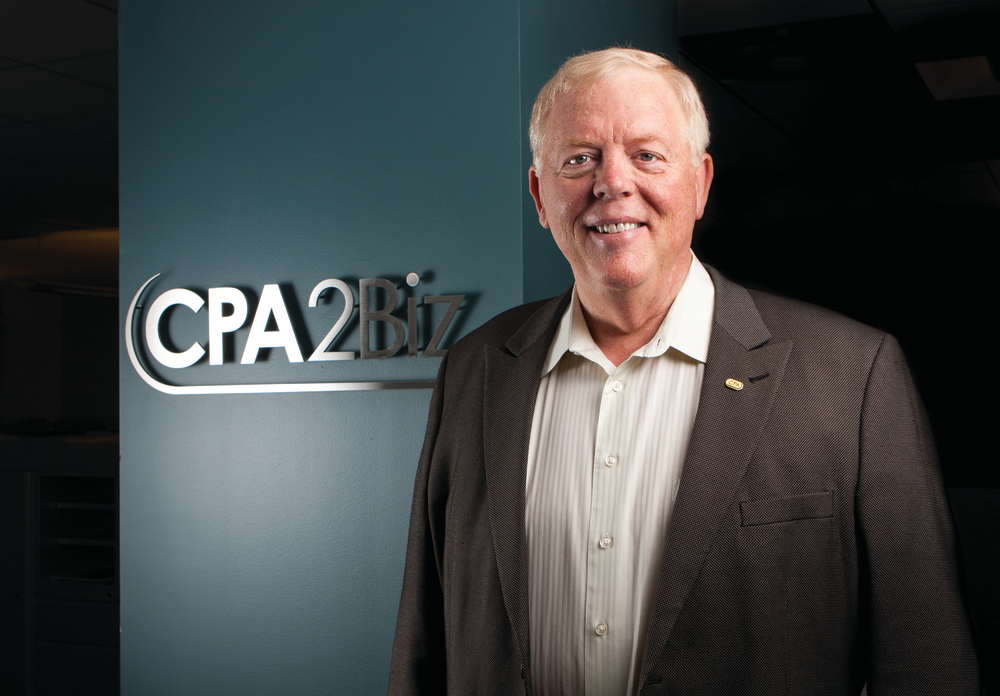




There are few accounting professionals that have had the opportunity to serve in multiple roles and gain insight from several unique vantage points over the course of their career. Greg LaFollette is one of the few. I met Greg early in my career. He quickly became a friend, then a mentor, and today is a well-respected colleague.
As a part of our executive series, I wanted to include Greg and share his vast knowledge of the profession with our readers. Because Greg has served in numerous roles—from firm partner to Executive Editor of a leading trade publication—he offers a distinct and relevant perspective on the profession and where it is heading.
To begin, I would like to offer a snapshot of Greg’s background:
- Practiced public accounting for more than 27 years.
- Served as a partner in a large CPA firm in Sioux Falls, South Dakota.
- Held the position of VP of Product Strategy at Thomson Reuters (then called Thomson Tax and Accounting).
- Served as Executive Editor of The CPA Software News, which he transformed into The CPA Technology Advisor—launching the digital version of the publication and advancing the magazine to a top-three trade publication.
- Currently serves as VP of Product Strategy for CPA2Biz—focusing on helping accounting firms to move to the Cloud and work differently.
Greg has had a great impact on the profession and on me personally. It was during Greg’s time at Thomson Reuters that we became acquainted. It wasn’t long after getting to know each other that I received a call from Greg, requesting that I be part of a product advisory group for Thomson.
A few years into our relationship, I met up with Greg at the Thomson Reuters Users’ Conference. By this time, Greg had assumed the role of Executive Editor of The CPA Technology Advisor. I relayed to Greg that I admired what he was doing for the profession and that I would like to follow in his footsteps. He responded by telling me that he was approaching 60 and thinking about an exit plan, and that we would most certainly talk.
A few weeks later, our mentor-mentee relationship began. He enlightened me to the inner-workings of the magazine and how to be a consultant to the vendor community and the profession as a whole. We’ve been friends and colleagues ever since.
Today, as Executive Editor of CPA Practice Advisor, I have the opportunity to bring Greg’s knowledge to the forefront and share it with our readers…just as he shared it with me, one-on-one, over the years. While we were both in Chicago recently, I had the chance to sit down with him and ask him a slew of questions.
Darren: How many years did you actively practice in public accounting?
Greg: Twenty-seven—from 1972 until I joined Thomson in 1999.
Darren: Tell me a little about the practice you ran?
Greg: It’s a large local firm in Sioux Falls, South Dakota—full-service with about 20 staff. The firm still exists and my former partners are still my good friends. I occasionally take bagels in on a random tax-season Saturday.
Darren: You spend a lot of time at the CPA2biz offices in New York and California and you’re on the road speaking often –where’s “home”?
Greg: I choose to live in my home town of Sioux Falls, South Dakota. When I’m there, I office with Eide Bailly. That way I get to hang around practicing accountants (I love the smell of tax reruns in the spring!) The partners at EB are very kind and I very much appreciate their ongoing hospitality.
Darren: What are the core differences from when you ran your firm to running a firm today?
Greg: Back then we were the only technology-oriented, fixed-fee billing firm I knew of. Even so, we still worked way too hard at about 2,800 to 3,000 hours a year. We were a generalist firm, took what walked through the door. It was almost impossible to be a niche firm back then. Today, technology enables a firm to specialize because it removes time and geography. I worked the 2800 hours at my desk 35 years ago, which was a lot of time away from my family. Today, if I were doing it again, I would probably work as much, but I would do it when I want from where I want, and often times in bits and pieces.
Darren: You ran a CPA firm, served as VP of Product Strategy at Thomson Reuters, turned CPA Technology Advisor (now CPA Practice Advisor) into a premier publication, and now lead product strategy for CPA2biz. That’s an expansive, diverse career. Tell me, if you were starting a new practice today, with all your experience, what would your vision of that practice be?
Greg: I would be way more focused on what I do, how I do it, and for whom I do it. I would grow a practice to support the lifestyle I want to live. You teach this stuff everyday, Darren. You tell firms to create a business model first…I agree with you I would ask myself what kind of business I want to run, and then I would create it. From a technology standpoint, I would include a great big fat Internet pipe, a firewall, a router, a scanner, and some low-end computers. Oh hell, and I suppose I’d get forced into buying at least one printer, too.
Darren: It seems the rate of change in technology is faster today than ever. With that said, what do you see as the biggest challenge facing firms today?
Greg: The movement from premise-based to SaaS is perceived as very technologically challenging. It’s not. The biggest challenge here, hands down, is staff and client management and standardization of workflows. The next biggest challenge is getting firms to think differently about the services they provide. The services they have traditionally provided are not necessarily the ones clients have wanted or will want in the future. Firms have to understand this and implement the technology to help them deliver these new services.
Darren: What would you say is the one thing (or two) that has given you the greatest satisfaction?
Greg: I had a great mentor early in my career. Walt Schaefer was my boss when I was business manager at a social services agency. He taught me the power of “connections.” Today, I pride myself on knowing almost everybody in the accounting technology world. Years ago I founded a gathering that’s now known as the SaaS Executive Roundtable and every January 50+ CEOs of technology companies that serve the profession come together to spend two days trying to figure out, collectively, how to do it better.
Other high points have been the opportunity to associate with great people. I’ve had great talent work for me (Theresa Mackintosh when we were both at Thomson), and with me (Darren Root as we prepared the transition when I left the magazine). I’ve also worked for great people, most notably my current boss at CPA2Biz, Erik Asgeirsson. Each of these people has and is still making a profound impact on the profession. It doesn’t get any better then that!
Darren: If you were advising a 25-year-old CPA looking to get into public practice today but with a desire to break the “traditional accounting firm mold” of long hours, etc…what advice would you give?
Greg: Make sure YOU control the CPA-client relationship. You’re the expert and as such you design the process and define the tool set. The fee dollar you collect by going outside of your standardized system will be the most expensive dollar you ever earn!
Darren: What do you see as two of the most exciting technologies that firm owners should be paying attention to today?
Greg: Easy—Cloud and mobile. They make each other possible and relevant. In five to seven years there will be no more premise-based software in public accounting. Everything will be Cloud-based, and everyone will access whatever he or she wants, whenever they want it, using whatever device they choose. And those devises will be mostly mobile.
Darren: Over the past few years, CPA2Biz has evolved to include a technology product mix. More specifically, you guys have adopted Cloud messaging. What do you see as CPA2biz’s role in the accounting space over the next several years?
Greg: For years we’ve been teaching accountants how to “use” technology to do what accountants have always done, but do it faster. Now we’re teaching accountants how to do things they’ve never done before.
Darren: Help our readers understand what it means that you lead product strategy and what CPA2biz’s role is here?
Greg: As you might imagine, we have many opportunities to partner with different vendors, representing many different products. Most are good, some not so much, and a few are excellent. Product Strategy listens to the marketplace (practitioners) to identify pain points, match them with solutions, and then size and sequence those opportunities. In other words, we go find best-of-breed products that will be most helpful to the profession and then present those products as part of our Trusted Business Advisor program.
Darren: You guys are launching a new event this October—the Digital CPA Conference. What is the goal of this conference and who should attend?
Greg: Digital CPA is the first-ever, Cloud user conference. It’s offered and co-sponsored by the AICPA and our strategic business solutions partners. It’s designed to help firms embrace Cloud technology as a strategic opportunity to move to a truly digital practice. There are several key groups that should attend, including client accounting services practice leaders; staff and users of our Cloud solutions, including Intacct, Bill.com, XCM, Confirmation.com, and Paychex; technology champions responsible for implementing Cloud solutions in their firms; and marketing directors or new business development directors.
Darren: One of the biggest challenges firm leaders face today is finding and selecting the right technology solutions. This is not an easy task, but an incredibly important one, because the right technology drives everything from firm workflow to profitability. What advice would you give firm leaders trying to navigate and make these decisions?
Greg: Selecting the right technology solutions is a really big challenge for firms. That’s why suites have done so well over the past dozen or so years. Firms used to be “best-of-breed” decision makers, and then the big suites started to come in and most of us migrated to a “good enough” style. In other words, if I needed a depreciation program, I would just buy the module from my suite, assuming is was good enough, but knowing full well that it wasn’t best of breed.
I see the Cloud changing that approach, and firms are beginning to use the Cloud to hook best-of-breed products to other best-of-breed products. It really is going to boil down to workflow, so “good enough” might not be good enough anymore if it affects workflow in a negative way. Vendors must open their platforms to allow other leading Cloud vendors to connect. This will be really powerful for the profession.
Darren: While you don’t seem to have retirement in mind any time soon, what advice do you have for the 50 or 60-somethings out there on positioning themselves for firm succession?
Greg: You’re right; I’m not going anywhere. As long as I’m having fun (and I am), my health is good (and it is), and my wife tolerates my crazy schedule (and she does), I’ll be right here trying to help firms work smarter and serve their clients more collaboratively. My advice to my almost-the-same-aged colleagues is to apply the same criteria, and keep having fun!
I would also say to build a firm that allows you to do whatever you want from wherever you want and enjoy it. Have fun, there is no set rule that when you hit 65 that says you have to stop having fun. I would also suggest that you find someone to mentor, because what you will find is that you learn just as much from the relationship as the person you are mentoring.
Sign in to get access to this free resource, and all of our whitepapers and reports.

Download this content today!
Register Now Already registered? Click here to Log In
Tags: Firm Management