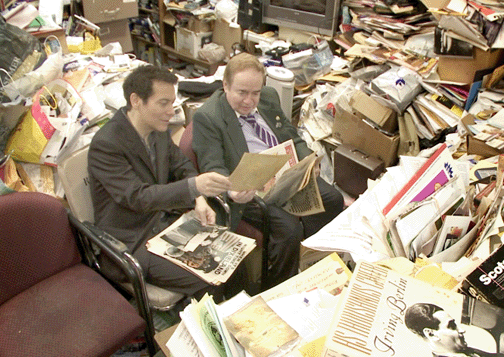




Businesses across the globe are operating deep within a transitional period. Change has been underway for several years, and the end result is very near.
Throughout history, every great idea has been met with some resistance. In order for change to happen, transition must first take place and this often scares people. It is the transition, not change itself, that is the most unnerving.
The switchover from paper to digital files still meets resistance, but it is getting weaker everyday as they find diminishing reasons to hold up their belief that paper is better than dealing with digital documents.
However, transition takes time, which is a commodity that most people in business perceive as a limited resource. What they don’t realize is that transition banks time as an investment and gives it back to you at a later date, with interest.
The music industry was caught out by its unwillingness to accept digital files as a legitimate way of distributing music. As a result, sales of physical format music have fallen year-after-year as the large recording studios continue to be baffled as to why they are not profiting in the same way as they once were.
The attitude of resistance and stalling to see what happened proved detrimental to the music industry as a whole. Artists suffered too as they earned less due to illegal downloading, while the consumer had less choice in the type of music they could buy. Lessons to be learned:
Make Clouds, Not War
For many, even those who are otherwise very tech inclined, a pen and notepad is still the best way to record and formulate ideas. For me, sometimes seeing something in plain black and white text on a sheet of paper is more conducive to concentration than a small digital screen.
The problem, of course, is that you cannot carry around a thousand notepads, or miss out on an opportunity because you left the correct one at home or back at the office. It’s the same in accounting. You’d be pretty peeved with your own accountant if they misplaced important receipts that were needed to file your tax returns.
With Cloud Computing, you keep digital records which allow you more time and freedom and offer your client more flexibility, security and instantaneous service that is unrivalled.
Society as a whole operates in an increasingly paperless world. Newspaper and magazine sales are down as people get their news and entertainment on PCs and mobile devices. People don’t send letters anymore, they send email, which is much more convenient, cost-effective and speedy. Even important documents like bank statements are delivered to customers through the web.
Hardened “old school” business types may still cling to the concept of the “hard copy” with what they think is good reason. They just can’t get away from using paper to conduct their business – it’s simply a part of their mindset. Others have just never known any other way and are unwilling or unable to facilitate change. What they don’t realize is that the benefits of going even partly paperless are numerous, and it’s not hard to make the switch.
It doesn’t take hours to become a paperless, or partly paperless, business. There are a plethora of applications that can be quickly downloaded and are user friendly and ready to use in minutes. Some are free and others are available at varying cost subject to your needs.
Google Drive is the benchmark for work projects that need a collaborative effort and require constant updating. It is a good in-house tool for the working environment. Dropbox offers a similar type of service and can also be used to back up important personal files. Box.com offers a range of different services to the more advanced user or business.
Bookkeepers and accountants have an industry specific application, LedgerDocs, that allows financial documents to be securely emailed directly into its system, or via a portal.
It’s all about identifying what your business needs and then utilizing the correct app to make your day-to-day business run as smooth as a 57’ Chevy when it first came out of the GM plant 55 years ago.
Benefits
- You’ll never lose important documentation if you have a backed up digital copy.
- You don’t have to carry as many bulky documents and folders around when travelling.
- You can reproduce your documents as many times as you see fit without ever having to worry about the cost or the effects on the environment.
- You can carry your entire portfolio with you wherever you go and access it at the touch of a button.
- Filing time is significantly reduced and staff resources are freed up for better use.
As tablets, smart phones, laptops and other mobile devices become cheaper and more popular with the general public, customers will expect you to use these innovations to conduct your business on a daily basis.
You don’t even need to change completely, not at first. You can have the best of both worlds by reaping the benefits of new technology, while also satisfying your desire to maintain paper records.
With an electronic data storage system, tailored to the needs of your business, you can manage and access your client documentation quickly and easily in electronic format on a day-to-day basis. And you can keep your paper files and produce them when they are absolutely required, but you don’t have to go rummaging around for them as often, wasting hours retrieving and re-filing.
Don’t get left behind
If you want more time to expand your business and client base, meet the ever changing needs of your clients quickly and seamlessly, be more efficient and increase your revenue … then applications for digital storage can help you to achieve all those things.
The transition from paper to digital is well underway, and accepting this change means you won’t get left behind like some others will be. The mind-set will eventually change, it’s just that some are slower on the uptake than others. Don’t let them hold you back. Experience the benefits of digitization for yourself now. Don’t fight it.
Sign in to get access to this free resource, and all of our whitepapers and reports.

Download this content today!
Register Now Already registered? Click here to Log In
Tags: Small Business