
Payroll
Tapping into the Payroll Revenue Stream
Abandoning old biases, Manning transformed payroll from a hassle into a hellavalota opportunity and future profit. For years, Sean Manning, CPA and president of Manning & Company, PC, held fast to the notion that payroll was more of a pain than a profit-surging service. And he wasn’t alone — most practitioners felt the same way … and still do.
Aug. 25, 2011
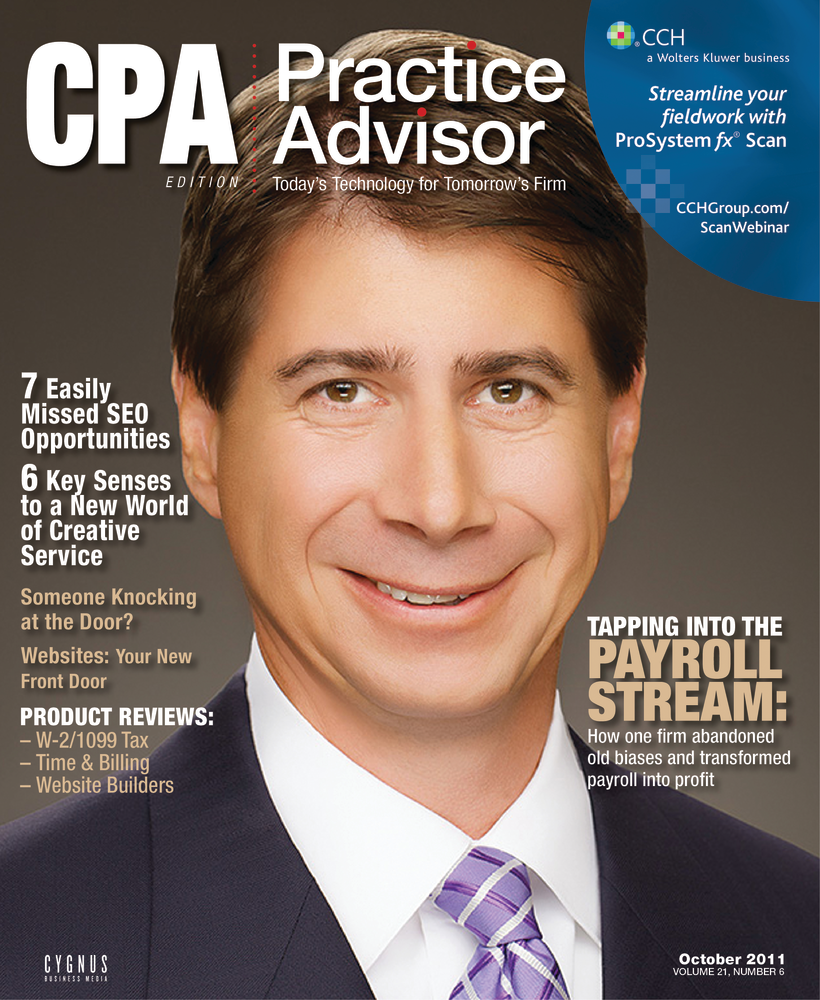
R. Sean Manning, CPA, President, Manning & Company, PC & Payroll Vault
Abandoning old biases, Manning transformed payroll from a hassle into a hellavalota opportunity and future profit
For years, Sean Manning, CPA and president of Manning & Company, PC, held fast to the notion that payroll was more of a pain than a profit-surging service. And he wasn’t alone — most practitioners felt the same way … and still do.
“Payroll has the reputation of being a problem rather than a solution,” Manning stated. “But the fact is that payroll itself is not the problem, it’s how firms choose to handle it.”
The traditional payroll services model houses payroll with other services — accounting, tax, audit, bookkeeping, and so on. Manning affirmed that for payroll to be a moneymaker, it must be segregated.
“Firms that follow the traditional model typically support less than 100 payroll clients … usually between 25 to 50 because that’s all the firm can handle,” Manning asserted. “Payroll requires its own system and a dedicated staff.”
Manning bought his father’s firm in 1998, but it wasn’t until a decade later that he launched his lucrative payroll business, which he uniquely branded Payroll Vault.
“I am firmly in the payroll business now,” Manning said. “After launching Payroll Vault in 2008, we more than doubled in size by 2010.”
Traditional v. New Payroll Services Model
Manning’s service model carves payroll out from his firm’s broad operations.
“Having payroll as part of my core accounting system doesn’t work. Payroll requires a dedicated staff, not just a bookkeeper to handle payroll tasks as they come through the door … in between bookkeeping duties,” Manning stated. “That’s when payroll processing really does become a hassle.”
In order to grow his payroll business beyond the profession’s average of 25 to 50 accounts, Manning knew that he needed to establish a dedicated payroll department. So that’s what he did.
Manning’s “new” model segregated payroll from other services, complete with its own workflow system, technologies and staff.
“I knew I had to make a substantial investment up front to launch Payroll Vault,” Manning recalled. “But I also knew that with a dedicated payroll business I could capture hundreds of accounts and process them with far more ease and efficiency.”
At the core of Manning’s model is growth. With an established system and dedicated staff in place, there is no payroll ceiling. His payroll business is well positioned for steady uncapped growth.
Manning recognized early on that to grow his payroll business, he would need to implement it in stages. He launched Payroll Vault with a payroll specialist, an operations manager, and a defined workflow process in place. From there, he would build onto the business as needed to keep up with growth.
“I took a staged approach with my payroll business. Once all the initial pieces were in place — technology, process and staff — I set a goal for increasing business the next year, and then the next. As needed, I invested in new staff and/or technology. At each stage of growth, there was an upfront investment, but ultimately, new business more than made up for it,” Manning explained.
Manning’s big vision is to grow his practice to 500 payrolls over the next few years, and more thereafter. And with a structured plan in place, he’s in a good position to make that happen.
Marketing & Sales: Key Components for Success
Like any firm, Manning has experienced client attrition.
“The average loss in the profession is about 10% a year — the combination of a bad economy forcing businesses to close, disgruntled clients that go elsewhere, or clients that decide to process their payroll in house.”
Because client loss is part of running a business, Manning knew he needed to implement a marketing program to continually generate leads and keep the sales funnel full.
In 2010, Manning’s wife, Marilyn, took the lead on marketing efforts. She attended seminars and events to generate leads. She also reached out to banks, attorneys and HR professionals to build a solid referral base. Within months, leads were flowing in. However, the problem was that there was no one dedicated to follow up with prospects.
“That’s when I knew it was time to enter a new stage,” Manning said. “I needed to hire a salesperson to manage leads, work the referral program and serve as the key point of contact for new business.”
A full-time sales person represented another round of expense, which quickly paid for itself with 40 new payroll clients in less than six months.
“Marketing and sales are critical components of our business model,” said Manning. “And firms that don’t think so will find themselves stuck at 25 to 50 payrolls for the long term.”
Testing the Waters Before Tapping into the Stream
Sean Manning didn’t just jump into the payroll business blindly. He did his research. He spoke with colleagues and examined successful payroll operations within other firms.
“I learned from those around me who had already figured it out. I observed firms that were successfully running separate payroll departments … studied their operations.” Manning explained.
Manning described this period as his time in the classroom. “I was patient … did the research required before taking a single step into the payroll arena.”
Today, Sean Manning is at the helm of a successful accounting firm and a highly lucrative payroll business. In relation to Payroll Vault, growth has been steady. His phased approach to business growth has enabled him to more than surpass the profession’s average 25 to 50 payroll accounts. In fact, his firm is approaching 200.
The days of viewing payroll as a headache and a hassle are long gone for Manning. “Payroll represents my bread and butter. I have a streamlined system in place, and I have the right people in the right positions to handle processing, broad operations, and marketing and sales.”
The key message here: Adding payroll takes more than simply shoehorning it into existing firm operations. It requires doing some upfront research, creating a separate workflow, investing in the initial infrastructure, and building a dedicated staff to oversee operations and ongoing sales.
For those looking to tap into the lucrative payroll stream, they would be wise to study what Manning has done. His revenue stream is not simply flowing; it’s raging.
[CALL OUT BOX]
Stats at a Glance
- Firm website: www.manningco.com; www.payrollvault.com
- Year founded: 1977; purchased from father in 1998; launched Payroll Vault 2008
- Total employees: 11 F/T
- Home base: Littleton, Colorado
- Firm description: Full-service public accounting firm with segregated payroll practice — Payroll Vault
- Payroll application of choice: Thomson’s Service Bureau Payroll